

The Renegade Chevalière: Pierre Beaumarchais, Pt. II

The decorated veteran, diplomat, and spy, the Chevalière d'Éon, loyally served the French crown for decades. But then she decided to blackmail the king. With nowhere to turn, the French monarch enlisted Pierre Beaumarchais to talk the rogue chevalière out of it.
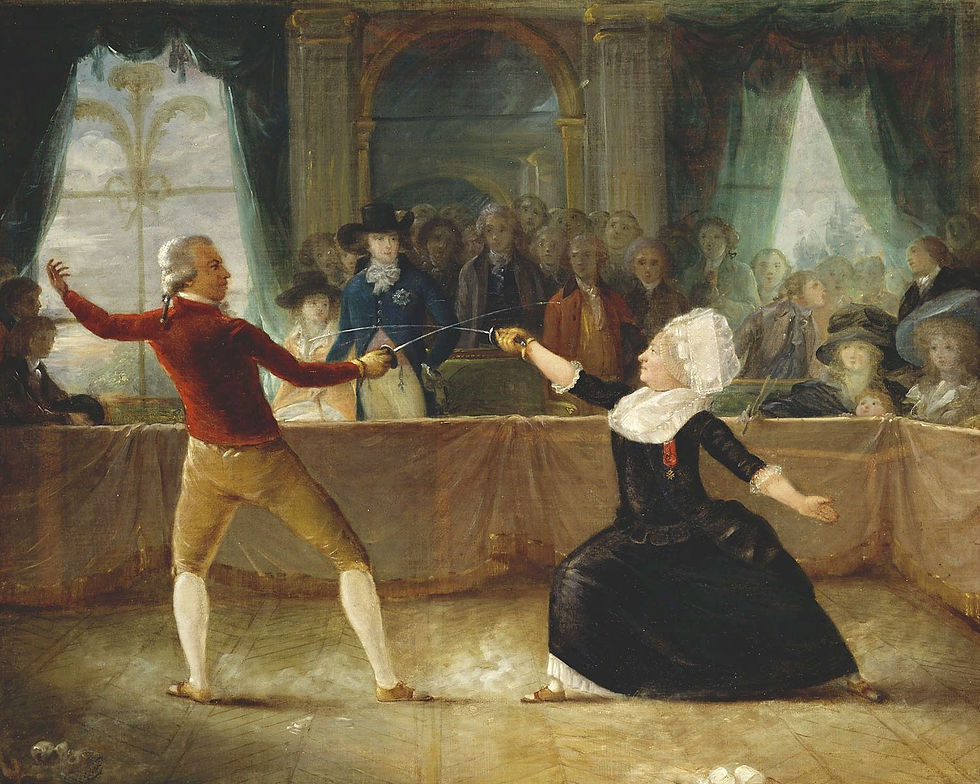
Above: The Chevalière d'Éon fencing with Monsier de Saint-George.
TRANSCRIPT
It was just another day at Jonathan’s coffee house in London—that is, until one guest challenged everyone else to a duel. The café was housed in a wood-framed building with a line of small windows. Sparely furnished and with rough-hewn flooring, the main room occupied the second story, at the top of a narrow stairway. Jonathan’s stood a short walk away from the Royal Exchange, the commercial center of the City of London, and because of this location, the coffee house acted as the de facto stock market of eighteenth-century London. Every day, bankers, merchants, investors, and stock traders (colloquially known as stock jobbers) bought and sold shares over a cup of hot coffee there. Whether they traded stock, sold cotton, or lent money for a living, everyone at Jonathan’s was willing to bet on virtually anything—it was a beloved pastime.
In early 1771, the patrons were gambling on a question that had the whole town talking. The conversation centered on an individual known as the Chevalier d’Éon, a decorated war veteran and celebrated French diplomat. Somehow or other, rumors had spread that d’Éon was a woman masquerading as a man, and gamblers started putting money on whether she was truly male or female. At Jonathan’s, plenty of customers were wagering that d’Éon was a woman, snickering and smirking at the idea of a lady waging war on the battlefield and politicking with Members of Parliament.
All of a sudden, the room fell to murmurs as an imposing figure strode into the coffee house, dressed in the crimson and ivy-green uniform of the French dragoons, an elite military brigade, walking with swagger in knee-high boots. In one hand, the newcomer held a walking stick heavy enough to crack a skull. It’s easy to imagine that several gulped as they recognized d’Éon. Having claimed their undivided attention, the soldier asked whether a “money broker” by the name of Mr. Bird were present. A moment later, Mr. Bird rose and identified himself. Though soft-spoken by nature, d’Éon looked eyes with the financier and launched into a full-throated tirade. D’Éon had heard that Bird was the scoundrel who had started these “impudent” bets. D’Éon commanded Bird to beg for forgiveness—right here, right now. For his part, Bird might have liked to sprout a pair of wings and fly out the nearest window, but instead he offered a meek justification. By law, he sputtered, English subjects could hazard money on whatever they pleased, even on issues involving the royal family. D’Éon silenced him before he could finish, and brandishing that heavy walking stick, the battle-tested veteran proposed that that they settle the dispute by force. White as the sugar they had spooned into their coffee, Bird and his associates sat in unbreathing, unblinking silence. Satisfied that they would quit their “impudent” betting, d’Éon wished them a good day and turned to leave.
An early biographer of d’Éon described the dragoon as “one of the strangest challenges that history has ever offered to fiction.” D’Éon does seem like a character that only a novelist could have dreamed up, partly due to the issue of gender. Six or seven years after scaring the hell out of those gamblers at Jonathan’s, d’Éon publicly declared herself to be a woman. In her memoirs, she related that she was born a girl and raised a boy, living the first half of her life as a male and the second half a female. Because she ended up as a self-identified woman, I’ll refer to her with feminine pronouns as well as the feminine noun, chevalière.
But d’Éon’s gender identity is only part of what made her so remarkable. She worked as a spy for Louis XV before blackmailing both him and his successor, Louis XVI. In 1776, to neutralize d’Éon, Versailles enlisted a secret agent who had negotiated with blackmailers before—Pierre Beaumarchais, watchmaker, harpist, polemicist, playwright, and international arms dealer. Today, we’ll hear how the Chevalière went to Russia and England as a spy, how she betrayed the French king, and how Beaumarchais did his best to talk her out of it. This is The Art of Crime, and I’m your host, Gavin Whitehead. Welcome to episode 2 of Spy vs. Spy . . .
The Renegade Chevalier
Early Transformations
The Chevalière d’Eon acted the part of boy since childhood. Born in 1728, she came into the world a girl, she asserted in her memoirs, much to her father’s disappointment. He had always wanted a son and was overjoyed when his wife gave birth to one early in their marriage. But then the boy died within a matter of years, leaving d’Éon’s father heartbroken. So when d’Éon, the second of two daughters, came along, her father decided to raise her as the son that he so desired. Despite major reservations, d’Éon’s mother went along with the gender switch, partly because her grandmother, a filthy rich noblewoman, vowed to pay the young family 120,000 livres to support a boy’s upbringing. Shortly after d’Éon’s birth, mother and father baptized their newborn as Charles-Genevière-Louis-Auguste-Timothé d’Éon de Beaumott, a name that pays homage to both male and female saints.
As d’Éon matured, she developed strikingly androgynous features, with icy blue eyes, an unblemished complexion, and blond hair tumbling downward in ringlets. She may have had certain feminine physical attributes, but she was never known to behave like a lady. According to historian John Richard Paul, author of Unlikely Allies, she “smoked, drank, and swore like any hardened sailor.”
From an early age, d’Éon seemed destined for a career in politics or perhaps the military, both of which were open exclusively to men. At thirteen, she matriculated at the College of Mazarin at Paris, where she studied the finer points of civil and canon law, graduating after eight years. By age twenty-five, d’Éon had published weighty treatises on finance and government that grabbed the attention of government officials. D’Éon was as confident with a sword as she was with a pen, having mastered the parries, thrusts, and footwork of fencing. She also felt at home on horseback. Thanks to her assorted athletic endeavors, she boasted a lean yet muscular build.
The King’s Secret
It was thanks in part to d’Éon’s knowledge of international affairs that she became a member of the so-called King’s Secret.
King Louis XV had established a network of spies that numbered around twenty by the end of his reign, with agents operating in capitals across Europe. Dubbed the King’s Secret, this cadre of spies remained, well, secret—top secret, in fact. Only Louis’s most trusted advisers had any idea of its existence. Even the monarch’s successor, Louis XVI, was kept in the dark about the Secret until shortly after he took the throne in 1774. The organization needed to stay concealed partly because its members took actions that contravened official government stances,even violating treaties. Louis XVI discontinued the King’s Secret not long after taking up the scepter. The organization’s activities would not come to light until the early 1790s, when French Revolutionary activists pried open one of Louis XVI’s closets and discovered a hidden compartment inside. It contained a trove of classified documents, including correspondence between Louis XV and his spies.
In 1755, Louis XV called upon his operatives to resolve a potential international crisis. As at so many other points in history, the French and English were bitter rivals. In 1755, the English made an effort to strengthen ties with Russia, pledging funds to beef up its military, a move that worried the French. France had shown hostility toward Russia for more than a decade—diplomatic relations had more or less stalled. If possible, however, France was eager to patch things up with Russia before the English forged an alliance. The prospect was entirely improbable. Russia’s ruler, Empress Elizabeth I, was rumored to be willing to revive the friendship between her homeland and France. But these rumors were just rumors, and Louis and Elizabeth eyed each other with suspicion.
Determined to get details on what the English were up to, Louis XV turned to one of his trusty spies, the Chevalier Alexander Peter McKenzie Douglas. The monarch instructed Douglas to find out whether the English and the Russians were indeed in talks about military subsidies and, if so, how close they were to an agreement. Douglas set out for St. Petersburg, and if anybody asked, he identified himself as a Scottish gentleman who had journeyed east “for health and pleasure.” Alarming news awaited the chevalier. England’s ambassador had already made inroads with the Russian chancellor, and they were about to finalize a deal, whereby the English would supply enough gold for Russia to garrison an estimated 30,000 troops on its western border, ready for battle with Prussia and France. Russia would be ideally positioned to launch an offensive against several of France’s allies, including Sweden, Turkey, and Poland.
While Chevalier Douglas was gathering this intelligence, Empress Elizabeth I warmed to the idea of opening a secret communication with Louis. Yet the two would have to correspond in French, and Elizabeth’s was rusty. The empress contacted the Prince de Conti, a Versailles power player and member of the extended French royal family, requesting that he find her a tutor. The ideal candidate would be a well-bred lady “neither too young, nor too old, [but] honest, well-informed, prudent, and discreet.” In addition to French, this language instructor would need to be fluent in cryptography, capable of translating Elizabeth’s writing into diplomatic code to ensure confidentiality.
The Prince de Conti knew the right young lady for the job—or to be more precise, the right young lady who was living as a man. The Prince de Conti had become acquainted with d’Éon thanks in part to her treatises. For whatever reason, Conti was privy to d’Éon’s true birth sex as well as to the fact that she had been raised a man. But apart from that, her command of French was masterful, her knowledge of politics first-class, and her personality winning. Empress Elizabeth would adore her as a tutor. So, in 1755, the Prince de Conti summoned d’Éon to his palatial residence. She found him in his sleeping quarters, reclining in bed with the air of a “grand sultan,” she recalled later.
“Mon petit d’Éon,” the de Conti began, “I have some news to give you that may upset you for some time, but which should eventually console you. I want you to retake your skirts in the service of a great foreign princess who is rich and powerful and who is aware of your talents.” D’Éon was shocked and not at all keen on the idea, largely because it would require her to trade for men’s apparel for women’s. She protested, “My lord, I cannot cry enough tears that would express to you what a cruel sacrifice it will be for me to leave a protector such as yourself, to abandon my mother and Paris and my male clothes to which I am so attached. If I believed that you had been planning to one day have me retake women’s clothes, I would not have devoted my studies to horsemanship or fencing.” The prince appealed to d’Éon’s love of king and country, however, eventually winning her over. Following a crash course in diplomatic ciphers and feminine deportment, d’Éon shipped off to the court of Empress Elizabeth I. With her, she brought two footlockers, one packed with masculine clothing, the other with feminine.
In France, d'Éon had played the part of the fetching young man for years. In Russia, she was called upon to enact a dual role. In public, she sported male attire, supposedly acting as secretary to Chevalier Douglas, the spy from France who was posing as a traveling gentleman in St. Petersburg. In private, d’Éon “retook her skirts,” introducing herself as Mademoiselle Lia de Beaumont. She presented herself to Empress Elizabeth in the guise of a young lady and immediately charmed her, gaining admission to her close-knit coterie of ladies-in-waiting. Soon after, Elizabeth agreed to hire the delightful Mademoiselle Beaumont as a French tutor. Having won the empress’s confidence, d’Éon revealed that she was masquerading as a woman. She had come to Russia not only to tutor her in French but also to facilitate covert communications between her—Elizabeth I—and Louis XV. As proof, she produced a secret message from the French king himself, hidden in a copy of Montesquieu’s book, The Spirit of the Law. The cover of the volume had a concealed hollow that was wide enough to store a few slips of paper. D’Éon’s revelation so beguiled the empress that she forgave the imposter for initially deceiving her. With the help of d’Éon, Elizabeth began an encrypted correspondence with Louis.
Historians have questioned how much of this tale of courtly intrigue is true. Most historians accept that d’Éon became a member of the King’s Secret and went to Russia as a spy. What’s uncertain is whether she led the sort of gender-bending double life I just described. That part of the story comes straight from d’Éon, who recounts it in her memoirs. The trouble is: apart from her reminiscences, there’s no hard evidence to back up the story. Intriguingly, however, Louis XV’s portraitist, Maurice Quentin de la Tour, made a sketch of d’Éon at around the time of her deployment to Russia, depicting the spy as a pretty young woman with rosy-red cheeks, wearing pearl earrings along with a lace cap. A neckline reveals an ample bosom. This illustration does not prove that d’Éon attired herself as a woman in Russia, but it does suggest that she had at least appeared in feminine attire.
Whether d’Éon wore dresses or britches at the court of Empress Elizabeth, relations between France and Russia blossomed during her time there. By 1758, the nations signed a a military treaty cementing their alliance. D’Éon could consider her mission accomplished. And the timing could not have been much better. By the late 1750s, the French were already engaged in war, and they needed all the help they could get.
Captain of the Dragoons
In 1756, the Seven Years’ War erupted. This conflict was global in scope, with fighting in Europe and the Americas. In Europe, France supported its new ally, Austria. The Austrians were trying to gain territories then belonging to Prussia. In the Americas, France warred with the English over competing colonial interests. Russia backed France and its assorted allies on the European battlefields. That under-the-wraps diplomacy had clearly paid off.
The Chevalière d’Éon saw the outbreak of the Seven Years’ War as an opportunity for her own advancement. In the mid-eighteenth century, members of the French nobility often served in the military as a first step roward securing high-paying offices and pensions. On expressing her readiness to fight, d’Éon was assigned to the Army of the Rhine. Louis XV appointed her to the prestigious rank of captain of the Dragoons, an elite brigade of warriors. D’Éon traveled to the frontline in summer 1761, setting up camp in what is now Germany. She showed bravery in battle. In one skirmish, she led a small contingent against a much larger Prussian battalion and captured them. At one point in combat, d’Éon sustained injuries to her head and thigh when her horse crashed to the ground, crushing her in the process. Impressed by her performance, one of her commanding officers reported that she had “upon several occasions, given proofs of the greatest intelligence and of the greatest valor.”
D’Éon’s competence and courage would not suffice to win France the war. The conflict ended in a rout for them. With the fighting ended, d’Éon went from warrior to diplomat, traveling to England in September 1762 to take part in peace talks and acting as secretary to the ambassador of France. In January of the following year, she and other French emissaries toiled over the exact phrasing of certain clauses in the treaty—tedious though no less essential work. The most important provision concerned the French city of Dunkirk. In the eyes of the victors, this port sat perilously close to the English coast. To prevent France from launching an invasion out of Dunkirk, English negotiators demanded that the French destroy the harbor there. D’Éon pushed back, and thanks to her steadfastness as well that of her fellow French diplomats, the English dropped the requirement. Again, d’Éon had acquitted herself well, and again her superiors recognized her talent. The French ambassador to England praised her industry, describing her as “at work usually from morning to night.” The treaty was signed in February 1763.
Afterward, d’Éon stayed on in London as a diplomat. She had first come to the British capital as secretary to the French ambassador, but that ambassador resigned. As a result, Louis appointed d’Éon as Minister Plenipotentiary, basically an acting ambassador, a promotion that rewarded her hard work. Witty and intelligent, d’Éon thrived in her new diplomatic role, earning the admiration of high-ranking statesmen and socialites alike. She even became a favorite of King George III.
They would not have thought as highly of her if they had known what she was up to in England. Almost before the ink had dried on the treaty, Louis XV hatched a plan to invade England, aided by the new chief of the King’s Secret, the Comte de Broglie. Louis’s ambitions were ill-advised, even delusional. France was teetering on the brink of bankruptcy because of the cost of the Seven Years’ War, and the treaty France had signed had reduced its navy to a fraction of its previous size. Waving away those massive handicaps, Louis wrote to d’Éon, commanding her to scout out optimal landing sites for an invasion of England. Once she the chevalière had conducted reconnaissance, she was to communicate her findings in code to the Comte de Broglie, head of the King’s Secret. Louis XV mandated in a letter to d’Éon that she “keep the affair strictly secret and that [s]he never mention anything of it to any living person, not even to any ministers.” Like a faithful spy, D’Éon accepted her mission. She cannot have failed to see the irony of it all. Just months earlier, she had played a small yet meaningful role in negotiating a treaty that ended the Sven Years’ War. Now, she was balling it up and tossing it in the bin.
In March 1763, d’Éon returned to Paris for further instructions. While visiting the French capital, she was awarded the Croix de Sant-Louis, the Cross of Saint Lous, France’s most prestigious military honor. In public, the king cited her valor in the Seven Years’ War as the reason for the award. But d’Éon would have known that it was her service in the King’s Secret that had won the decoration.
By about the age of forty, d’´Éon had obeyed her sovereign’s every command—as spy, soldier, and diplomat. And then she betrayed him. We’ll hear why after a quick break.
Blackmailer
The Chevalière d’Éon’s problems largely derived from one character flaw: she lived well beyond her means. Like plenty of people with noble ancestry, she had expensive tastes, and in London she kept company with a soft-living set. She was, after all, the Minister Plenipotentiary (or acting ambassador to England), which meant that she hung around with political and social elites. She couldn’t go around looking like some grubby shmo if she wanted their acceptance, and she stocked her wardrobe accordingly—and then restocked it and then re-restocked it. She explained in a letter, “When I was [secretary to the ambassador] I went about plainly dressed in my uniform and cambic cuffs; now, much against my will, I must wear a few decent clothes and a little lace.” Was it really against your will, Chevalière d’Éon? Anyway, she also spent a king’s ransom on wine. Whenever she hosted dinner parties, as she often did, she treated her guests to imported Burgundy. In a single day, d’Éon once purchased 2,800 bottles of the finest vintage for a colossal £1,500, well over $30,000 today. The British government even warned her that it might have to impose tariffs on her imports because they had grown so enormous.
D’Éon’s extravagance was becoming a liability, but then there was her naked hostility toward the Comte de Guerchy, the newly appointed French ambassador. Before he rolled up in London, d’Éon received word that the French government could not afford to employ both an ambassador and a minister plenipotentiary who could blow a year’s salary on a boatload of wine. As a result, d’Éon would be demoted to secretary to the ambassador. D’Éon was furious, not least because she had held a petty grudge against Guerchy since the two of them served in the Seven Years’ War. In October 1753, Guerchy stepped out of a carriage in front of the French embassy in London, located in Monmouth House on Soho Square. Soon thereafter, he met with d’Éon and presented her with a letter from the higherups. Because of d’Éon’s tantrum over her demotion, the king and his advisers had fired her and recalled her to Versailles. She was to leave straight away. That was nice, d’Éon told Guerchy. But she wasn’t going anywhere. Nope, she was staying right there in London as minister plenipotentiary, to hell with the king’s orders. In fact, the king hadn’t even signed the stupid letter Guerchy was waving in her face, so it basically didn’t count. When Guerchy informed the British foreign minister of d’Éon’s dismissal, d’Éon just told him to ignore all that. D’Éon took her meals at the head of the ambassador’s table in Monmouth House as if nothing had changed. Guerchy shared his breakfast with her in silence.
By early 1764, she was still angry about the state of affairs, picking up a pen to vent her frustrations. Soon, she had published a French-language account of her diplomatic activities in England, titled Letters, Memoirs, and Negotiations. In it, she detailed her recall to Versailles and painted Guerchy as unfit for office. The book caused a scandal, partly for offering a glimpse of the closed-door dealings that make up diplomacy. The initial run of 1,5000 copies quickly sold out. Letters was banned in France, where the publication of such sensitive government information was a punishable offense.
Even in London, she was in trouble. The authorities charged her with criminal libel for attacking Guerchy, generating wonderful publicity for d’Éon and boosting book sales. On the day of her hearing before William Murray, the First Earl of Mansfield, one of the most celebrated judges of the day, d’Éon didn’t show. Justice Mansfield ruled against her in her absence, calling for her immediate arrest. When law enforcement turned up at her residence, however, she was nowhere to be found. One story has it that police determined that d’Éon had gone into hiding in the home of a Mrs. Eddowes. Investigators followed this lead to Mrs. Eddowes’ home and asked to search the premises. The fugitive dragoon wasn’t there either. Instead, they found Mrs. Eddowes in the company of two ladies, seated by the fireside. It never crossed their minds of investigators that one of those women was the criminal in disguise.
Around the time of her conviction, d’Éon came forward with accusations of her own. She alleged that Ambassador Guerchy tried to poison her when he came by for dinner at the embassy in October. When she finished her meal, the dragoon recalled, a fatigue came over her, and her stomach ached. Fearing that she had been drugged, she excused herself and stepped outside with the intention of returning home. As she headed for the street, she encountered a gang of hired thugs at the front gate. They swarmed d’Éon, attempting to force her into a sedan chair, clearly in an effort to kidnap her. Dazed though she was, the expert fencer and hardened soldier fought them off and hurried home, collapsing into bed. She would not awaken until noon the next day, reinforcing her suspicion that Guerchy had sedated her. She could not be sure of the ambassador’s ultimate aim, but it seemed possible that he wanted her dead. Her fears were well-founded. It later came to light that Guerchy had offered d’Éon’s position as secretary to a colleague for the price of slipping opium into d’Éon’s wine. That individual refused, but Guerchy appears to have found someone else for the job. In a shock to both the British and French governments, a grand jury indicted Guerchy based on d’Éon’s allegations, clearly deeming them credible. The British prime minister intervened, arguing that Guerchy enjoyed diplomatic immunity, which blocked the case from going to trial. Still, Guerchy’s role in this nefarious scheme was not a good headline for France.
D'Éon spiraled into near-panic. She feared arrest—or worse, perhaps an assassination attempt—at any moment. That a horde of creditors were also after her for overdue payments only added to the stress. Now hypervigilant, she armed herself to the teeth, inventorying her arsenal in a letter to France: “I have at home no fewer than eight Turkish sabres, four pairs of pistols and two Turkish rifles.” In a bizarre turn of events, spectral moans emanated from her fireplace at night. In a far-fetched effort to scare her out of her wits, Guerchy hired a guy to climb on her roof and wail down the chimney. The effect was more farcical than frightening, but it was so annoying that d’Éon moved out.
D’Éon converted her new rooms on Golden Street into a fortress, hiring a team of ride-or-die dragoons to stand sentinel. She kept a red-hot poker in the fireplace, ready for use as a weapon if necessary, and left an oil lamp burning all through the night. That way, nobody could catch her by surprise. She even planted explosive around the property, prepared to blow herself into oblivion if there was no other way out.
It was during this hour of extreme vulnerability that d’Éon resorted to blackmail. She wanted that bastard, Guerchy, out of her life as well as enough money to support herself. Lucky for her, she had enough dirt on Louis XV to bury Versailles. D'Éon had published plenty of classified information in the Letters, but she had not told all. She had held back letters from Louis XV, in which the king had given express orders to identify where invading French vessels could land in England. She indicated to Louis in no uncertain terms that she would leak these missives if he did not meet her demands. In her words, she would be “forced into the arms of the King of England.” People would die if she went public with these letters, d’Éon warned: “[Y]ou will be determining the fate of the next war, of which I will certainly be its innocent author.” Throwing his hands in the air, Louis sighed, “there is nothing to be done with the mad except shut them up.” To appease d’Éon, the monarch recalled Guerchy and replaced him with another ambassador, whom the blackmailer preferred. Louis also offered d’Éon an annuity of 12,000 livres (more than $100,000 today). Even this large sum would not suffice to cover the cost of d’Eon’s extravagances.
Despite these victories, d’Éon’s life was often miserable. She became something of a political exile, no longer able to wine and dine the hoi polloi the way she had before as minister plenipotentiary. She looked over her shoulder wherever she went, worried that assassins might be trailing her. Then, she was humiliated in 1770 and ’71 when gamblers began betting on her true gender. Through it all, she longed for her homeland. If she had her druthers, she would leave London and return to France. After twelve long years, in 1775, the opportunity presented itself when a famous French playwright named Pierre Beaumarchais came to find her in London. We’ll hear about the dramatic negotiations that followed after a quick break.
The Return of Beaumarchais
As we discussed in the previous episode, King Louis XV of France had found a lot of use for Pierre Beaumarchais. First, he employed him as a royal watchmaker. Then, he hired him to teach his daughter how to play the harp. Then, Versailles deployed him as a secret agent to London. On his first mission, Beaumarchais struck a deal with the libelous pamphlateer Charles Théveneau de Morande. Morande agreed to destroy a lurid lampoon of Louis XV’s mistress, Madame du Barry, in exchange for a truckload of money. Everyone walked away from the negotiations satisfied, and Beaumarchais even befriended Morande.
In 1775, he received another assignment, this time from the Foreign Minister, the Comte de Vergennes. Vergennes informed Beaumarchais that the Chevalière d’Éon was still a thorn in the monarchy’s side because of her compromising letters from Louis XV. By now, Louis XV was dead, and Louis XVI was sitting on thre throne. But Louis XV’s unrealized plans of invading England were so explosive that that made no difference. If she shared this material with the English government, there would be trouble. Vergennes dispatched Beaumarchais to determine what it would take for d’Éon to relinquish her ammunition.
After his meeting, Beaumarchais packed his bags and headed for London. To avoid detection, he chartered a private boat from Boulogne and rowed through the night. A punishing easterly wind kept him from putting in at harbor. So, after seventeen hours of sea-tossed travel, he came ashore in Hastings, Sussex, south of where he had hoped to dock. From Hastings, he journeyed northward to London. Once settled in, Beaumarchais considered how best to proceed, knowing that d’Éon was a shrewd negotiator. If he sought her out, he migh look desperate. Better to bide his time and wait for her to make the first move.
Before long, d’Éon became aware of Beaumarchais’s arrival in the British capital. Like many in London, she knew of him, having read his acid takedown of the French judiciary, Memoranda Against Goëzman, as well as his delightful comedy, The Barber of Seville. D’Éon recalled later, “[J]udging by the boldness of his style and opinions, […] there was still a man left in Paris.” She imagined they had a mutual desire to meet each other: “Both of us probably felt drawn to each other by the kind of natural curiosity found in extraordinary animals.” D’Éon was not just interested in Beaumarchais for his writing. As it turns out, she was friends with the libelous pamphleteer, Morande, and knew that Beaumarchais had negotiated with Morande on behalf of Versailles. With Beaumarchais’s help, maybe d’Éon could cut a deal with Louis XVI allowing her safe return to France. She asked Morande where she could find the playwright, and Morande pointed her in the right direction.
One day, she called at Beaumarchais’s lodgings, uninvited. Wishing to make an indelible impression, she donned her the crimson and ivy-green uniform she had worn to intimidate the caffeine-high gamblers at Jonathan’s coffee house. Pinned to her chest was her pride and joy, the Cross of Saint Louis. When Beaumarchais opened up and welcomed her inside, d’Éon introduced herself in French, her speech flavored by the inflections of her native Burgundy. D’Éon indicated that she wanted to work out a deal with the French king, but Beaumarchais feigned a lack of interest. He was trying to rile up d’Éon, and it worked. First, she trumpeted her honorable record as a soldier and diplomat. The king of France had negotiated with someone as disreputable as Morande, a career libeler, she protested. Why wouldn’t he play ball with her? Beaumarchais held firm. He had not come to London for either her “friendship or [her] trust.” D’Éon was startled by Beaumarchais’s coldness, and desperation welled up inside her. Had she misplaced her hope in the playwright? Would she ever find someone to help her back to France? Ending the conversation, Beaumarchais showed the dragoon to the door. Finally, the decorated warrior broke down, erupting into sobs and flinging herself at Beaumarchais. “I am an unhappy woman!” she cried. Holding the weeping wretch in his arms, Beaumarchais suppressed a smile. This was the kind of vulnerability a savvy negotiator could exploit.
D'Éon had done more than lay bare her misery; she had outed herself as a woman to Beaumarchais. He would have heard about the wagers regarding her sex back when they started in 1770 or ’71. Rumors had traveled from London to France that d’Éon was female, fueling gossipy media coverage. Cartoonists even sketched the Seven Years’ War veteran fencing in skirts in what was conceived as a comical mashup of masculine athleticism and feminine dress. Now that the dragoon had identified herself as a woman to Beaumarchais, he suspected that he could use her gender as leverage in negotiations. After d’Éon left his lodgings, assured that Beaumarchais would help her, the playwright sent a letter to Louis, appealing to the monarch’s sense of chivalry: “When one thinks that this creature, so much persecuted, belongs to a sex to which one forgives everything, the heart is touched with a sweet compassion.” Beaumarchais continued, “I do assure you, Sire, that in taking this astonishing creature with dexterity and gentleness, although she is embittered by twelve years of misfortune, she can yet be brought to enter under the yoke, and to give up all the papers of the late King on reasonable conditions.”
Beaumarchais went back to France and conferred with Vergennes about how to bring d’Éon under the yoke. Beaumarchais proposed that they force d’Éon to out herself as a woman publicly. In so doing, she would expose herself as a decadeslong fraud, he argued, undermining her credibility. No English politician would take her seriously if she came forward with the incriminating letters from Louis XV. As a self-avowed woman, moreover, d’Éon would no longer be eligible to serve in the boys-only arena of diplomacy and would have no choice but to resign her post as minister plenipotentiary. Vergennes brought Beaumarchais’s plan a step further, suggesting that d’Éon be allowed back to France if and only if she were “willing to accept the costume of his sex,” in other words if she agreed to dress as a woman. (Apparently baffled by his own grand plan, Vergennes mistakenly uses the masculine pronoun in reference to d’Éon.) When Beaumarchais and Vergennes presented the plan to Louis XVI, the king further agreed to pay d’Éon a generous annuity of 12,000 livres for the rest of her life.
With the king’s approval, Beaumarchais traveled back to London and presented these terms to d’Éon. She thought long and hard about assuming a new identity as a woman. On the one hand, she understood that it would preclude her from taking part in politics. On the other hand, there’s evidence to suggest that the Chevalière d’Éon might have preferred to adopt the look and manner of a woman. For years before Beaumarchais entered her life, she had filled her wardrobe with dresses, petticoats, and women’s earrings, presumably for her own personal use. Still, it was not a decision that d’Éon would make lightly, and it would take months before she committed to the agreement.
The Transaction
While d’Éon mulled things over, Beaumarchais stayed in London, during which time the two became friends. D’Éon may have desired more than friendship, developing a full-blown infatuation with the playwright. While living as a man, she had never pursued romantic or sexual relationships with men or women. That appeared to change with Beaumarchais. She gushed to him in a letter, “My heart which has been closed to other men naturally opens in your presence, like a flower spreading itself out in a ray of sunshine.” In another, she called him “the shrewdest and nicest monkey” she had ever met. In still another, she quoted a line the playwright had written himself: “I repeat what Rosina says in [The Barber of Seville], you are made to be loved!” Whether Beaumarchais reciprocated her feelings is anyone’s guess, though he certainly grasped the absurdity of it all. He mused to Vergennes, “[H]ow on earth could I imagine that, to save the King zealously, I would have to become a gallant knight to a captain of the dragoons?”
By early November 1775, Beaumarchais and d’Éon finalized a contract, which they called the “Transaction.” In addition to the terms I mentioned a minute, the agreement stipulated that Louis would absorb the debts the chevalière had racked up while living large in London. The king even agreed to finance the purchase of d’Éon’s new feminine wardrobe. The Transaction permitted her to retain one of her regimental uniforms, along with her Cross of the Saint-Louis. The rest of the garments and accessories she had worn as a man were to be destroyed or otherwise discarded. Pleased with this outcome, d’Éon celebrated by buying a black silk gown. They signed the Transaction on November 4, 1775, backdating it one month to October 5 so it coincided with d’Éon’s birthday.
With everything squared away, d’Éon produced a strongbox, where she had locked her damning letters from Louis XV, handing them over to Beaumarchais, who brought them back to France, hidden in the same copy Montesquieu’s Spirit of the Laws that d’Éon had taken to Russia. The Transaction was complete, the crisis averted.
Beaumarchais’s Bet
But then, after months of negotiation, d’Éon threatened to break it all off. In an embarrassing repeat of what had taken place four or five years earlier, gamblers started betting on her birth sex. She read about the wagers in a newspaper article in the Morning Post. It ran on Saturday, November 11, 1775, one week after the Transaction was signed. She had not yet declared publicly that she was a woman, but word had gotten out that she was about to: “A new policy is preparing in the city on the sex of the Chevalier d’Eon; bets now run 7 to 4 a woman against a man; and a nobleman well known on the turf, has pledged himself to bring the matter to a clear decision before the expiration of fourteen days.” The timing was no coincidence, and D’Éon suspected that Beaumarchais had a hand in it. He knew, after all, that the Transaction required her to come out as female. With this inside information, Beaumarchais perceived an opportunity to make easy money—and a whole lot of it—by staking large sums on female. D’Éon was right. Beaumarchais had placed massive bets, claiming to Vergennes that he had wagered £100,000, well over $20 million in today’s currency. Fortunes were at stake, and d’Éon feared that investors would prevent her from leaving England until she proved her gender. It even crossed her mind that someone might try to abduct her.
Beaumarchais had not stopped at betting on d’Éon. According to hearsay, he swore to his friends that he was going to marry her, entertaining them with love ballads that he had written about the dragoon. D’Éon received a barrage of letters from old acquaintances in Paris, shot through with all manner of humiliating questions: Was it true that she was a woman? Was she really engaged to the playwright, Beaumarchais? D’Éon had considered Beaumarchais a dear friend and may have been in love with him. She was gutted by his betrayal.
Furious, d’Éon left London for Leicestershire, about 100 miles north of the capital. From there, she fired off a volley of piercing letters. “As to our approaching marriage,” she snarled at Beaumarchais, “according to what I hear from Paris, it can only be regarded by me as mere persiflage on your part. [… .] If you have made a serious matter of a simple pledge of friendship and gratitude your conduct is pitiable.” She refused to become “the dupe of gamblers who regard my sex as the means of fortune, like some gold mine in Peru.” Beaumarchais retaliated with threats: “My only sorrow will be to go back to France carrying the conviction that your enemies knew you better than your friends.” He went on, “it is with the most painful sorrow that I would force myself to change titles from your defender to your most implacable persecutor.”
Their friendship and partnership were irreparably damaged, and negotiations broke down between Beaumarchais and d’Éon. Bypassing the playwright, she communicated with Vergennes. After more than a year of back-and-forth, d’Éon accepted the terms of the Transaction, relinquished the remaining letters from Louis XV, and prepared for her return to France.
Transformations and Continuities
Beaumarchais washed his hands of the d’Éon debacle partly because he was attending to other matters that were equally if not more important in London. In 1775, the first shots were fired in the American Revolution. By 1776, France was neutral in the conflict—or at least they were pretending to be. In truth, the French wanted to aid the rebels however they could while maintaining the appearance of neutrality, mostly for the sake of make trouble for the English. (France would not officially enter the American Revolution on the side of the Americans until 1778.) As we all know by now, Beaumarchais was the guy you called if you needed a new watch for your mistress, harp lessons for your kids, or a covert trans-Atlantic shipment of military-grade firepower for an enemy of your enemy. Long story short, Beaumarchais was put in charge of organizing a secret delivery of weaponry and other supplies to the American colonists in exchange for tobacco, a valuable commodity. The schemer pulled it off, and the munitions reached the hands of American soldiers in time for the pivotal Battle of Saratoga. John Richard Paul argues that these armaments altered the course of the Revolutionary War. If you want to know more, check out his book, Unlikely Allies.
By the end of the American Revolution, Beaumarchais had led a full life by every measure, yet further glory lay on the horizon. In 184, after a hard-fought battle against censorship, his comedy, The Marriage of Figaro, opened in Paris and became a success of incomparable proportions. Thanks to its fierce criticism of aristocratic privilege, The Marriage of Figaro is often viewed as a precursor to the French Revolution. (If you want to know more about The Marriage of Figaro, make sure to listen to our episode titled “Marie Antoinette, The Marriage of Fiagro, and the Diamond Necklace Affair.”) In 1792, Beaumarchais followed up Marriage with the third and final play in the Figaro trilogy, The Guilty Mother, another smash hit. Like so many others, Beaumarchais narrowly escaped the guillotine-first-ask-questions-later hysteria of the Terror, dying of natural causes in 1799.
As for the Chevalière d’Éon, she made her long-delayed homecoming to France in August 1777. According to her memoirs, she wasted little time in presenting herself at Versailles, where she would receive instructions about how to commence her transition to womanhood. Marie Antoinette sympathized with d’Éon and arranged for her personal dressmaker, the famed Rose Bertin, to create a wardrobe for the chevalière. In addition, d’Éon received accessories form the finest milliners and wigmakers in Paris, including a lavish, three-tiered headdress. She wrote in her memoirs, “All I know is that my transformation has made me into a new creature!”
Thus transformed, the Chevalière d’Éon became a bona fide celebrity in France, buzzed about in salons and watering holes alike. She lunched with Voltaire and shared royal boxes with courtiers at playhouses. She also galvanized the pens and paint brushes of several visual artists. Several works contemplate her boundary-blurring gender identity. In one engraving, viewable on the Art of Crime website, she’s split down the middle, half male and half female. The left half of her is costumed as a woman, with a billowing dress and bird-feather headgear. Meanwhile, the right half is attired as a man, complete with frock coat and hose. My favorite image, also viewable on The Art of Crime website, is a painting by Abbé Alexandre-Auguste Robineau. It depicts a 1787 fencing match at Carlton House, Westminster. The fight pits a fifty-nine-year-old Chevalière d’Éon against the noted musician, composer, and biracial free man of color Joseph Bologne, the Chevalier de Saint-George, aged forty-one. Amazingly, d’Éon wore a black dress for the occasion, along with a headwrap. In the painting, she stands with her right leg extended in front of her, having just thrust at her opponent, evidently agile as ever despite her advanced age.
The riddle of d’Éon’s gender identity puzzled the public even beyond her death in 1810. The surgeon who conducted her post-mortem noted in a summary that she had “male organs in every respect perfectly formed.” This remark has thickened the mystery surrounding d’Éon’s gender identity. Had she lied about being born female and raised as a boy? Why? Historians may never definitively resolve those questions. However, many modern scholar who believe d’Éon to have been born a male and to have embraced her mid-life transformation have come to see her as a proto-transwoman.
Despite the many changes d’Éon experienced as a woman, she remained constant in at least one respect: she never forgave Beaumarchais for betting money on the question of her birth sex, savaging him in writing and greatly angering him. She spat, “I owe nothing but contempt to the man who wanted to empty the pockets of English gamblers and make an infamous fortune out of my sex.” Playing up her new feminine identity and loving every second of it, she condemned the unchivalrous beast “to all the women of my day for having tried to enhance his reputation by ruining a woman’s.” Beaumarchais may have won that bet back in London, but he certainly lost this war of words.


Comments