

The Suspect (S5E3)

Updated: Jul 24, 2025

Within a week or two of the shooting of Elliott Speer, Dean Thomas Elder, second-in-command at Mount Hermon School for Boys, became the prime suspect in the crime. After amassing as much evidence as possible agains Elder, District Attorney Joseph Bartlett called an inquest that would determine whether Elder would stand trial for the homicide.
Above: Headmaster Elliott Speer and Dean Thomas Elder, depicted alongside each other for the last time in Mount Hermon’s 1933-34 yearbook.
SHOW NOTES

Postcard depicting Cornell University’s College of Agriculture, at it appeared around 1905. In contrast to Elliott’s more conventional liberal arts training at Princeton, Thomas Elder studied animal husbandry at college from 1907-11. His expertise in cattle rearing landed him a job overseeing Mount Hermon’s farm, though some trustees would later suggest that his vocational education disqualified him from becoming the school’s headmaster.

In addition to his duties at Mount Hermon, Elder invested a lot of time and energy promoting the rearing of Holstein cattle, the breed depicted on this postcard, which was printed the same year that Elder graduated from Cornell and married his wife, Grace. His prominence in the Holstein world would prove a lifeline to him in the years following Elliott’s death.

R.C. Woodthorpe’s The Public School Murder enjoyed adulatory reviews throughout the British press. He went on to write seven more books, six of them murder mysteries. A former journalist, teacher, and assistant headmaster, Woodthorpe was elected to the exclusive Detection Club, a society of elite Golden-Age crime writers. Its members included Anthony Berkeley, Dorothy L. Sayers, and Agatha Christie.

On the day of the Speer shooting, Elder placed an advertisement for his political campaign in the local newspaper. When the dean became a suspect, his electoral ambitions were curtailed.
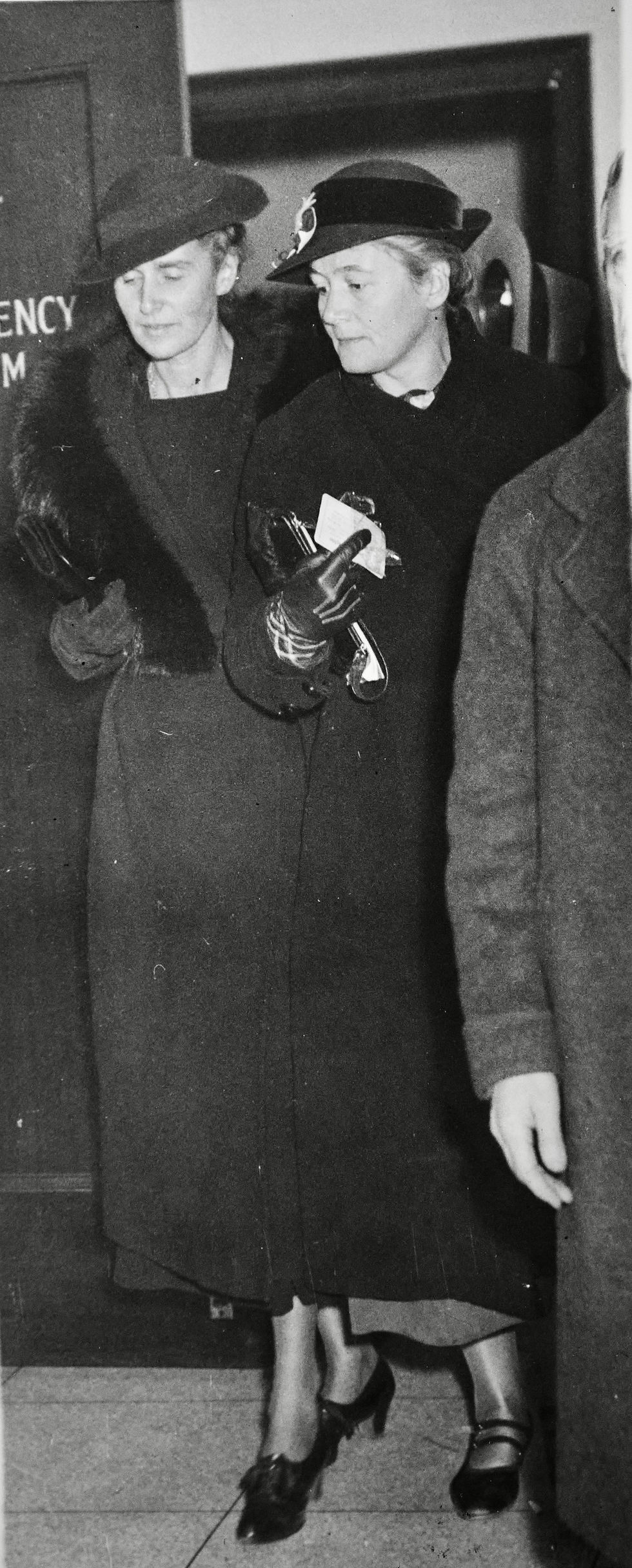
Holly Speer, leaving the inquest into the death of her husband. Mrs. Speer forever changed the way the world viewed the mystery of Elliott’s shooting when she revealed that he had loaned many detective novels to Thomas Elder, during the latter’s recovery from a heart attack. While the D.A. hoped that Holly could prove that Elder had borrowed The Public School Murder, her testimony revealed that she did not include mystery stories among her inventory of books her spouse loaned out.

For much of the inquest, Thomas Elder kept the press at an arm’s length. In this photograph—taken on the steps of the courthouse in Greenfield, Massachusetts—the dean (far left) is talking to two news reporters (on the right). In between Elder and the journalists is Elder’s friend, Richard “King” Watson. Watson graduated Mount Hermon in 1891 and became superintendent of buildings at the school. He was one of the only colleagues who never shunned Elder.
SELECT BIBLIOGRAPHY
Manuscript Materials & Archival Documents
--Moody, Frances Wells. Northfield Recollections. Northfield, MA: Dickinson Memorial Library (loc 929.2 Moody).
--Speer, Robert Elliott. Robert Elliott Speer Manuscript Collection. Princeton, NJ : Princeton Theological Seminary:
*Clippings and Mimeographed Material : Northfield schools. 1917-1942. - Northfield and Mt. Hermon Reports (Series VII: Clippings and Mimeographed Material. Subject File; Box 130, File 130:6).
*Letters Concerning Elliott Speer, 1915-34 (Series II: Correspondence; Box 25, File 25:5).
*Letters Concerning Elliott Speer, 1934 (Series II: Correspondence; Box 26, File Box 27, File 27:1-8).
*Letters Concerning Speer, Elliott. 1898 (Series II: Correspondence; Box 25, File 25:6).
*Letters: Family letters, 1911-1936. Folder 2 (Series II: Correspondence; Box 20, File 20:7).
--Various census records, passport applications, war records, yearbooks, birth and marriage certificates, Mount Hermon ephemera.
Books & Dissertations
--Amende, Coral. The Crossword Obsession: The History and Lore of the World’s Most Popular Pastime. New York: Berkley Books, 2001.
--Carter, Burnham. So Much to Learn. Gill, MA: Northfield Mount Hermon School, 1976.
--Coyle, Thomas. The Story of Mount Hermon. Mount Hermon, MA: The Mount Hermon Alumni Association, 1906.
--Curry, Joseph Robert. Mount Hermon from 1881 to 1971 : An Historical Analysis of a Distinctive American Boarding School. Ph.D. dissertation: University of Massachusetts Amherst, 1972.
--Day, Richard Ward. A New England Schoolmaster: The Life of Henry Franklin Carter. Bristol, CT: The Hildreth Press, 1950.
--Edwards, Martin. The Golden Age of Murder. London: HarperCollins, 2015.
--Edwards, Martin. The Story of Classic Crime in 100 Books. Scottsdale, AZ: Poisoned Pen Press, 2017.
--Marsden, George. Fundamentalism and American Culture. Oxford: Oxford University Press, 1980.
--Piper, John F. Robert E. Speer: Prophet of the American Church. Louisville, KY: Geneva Press, 2000.
--Straton, John Roach. The Menace of Immorality in Church and State. New York: George H. Doran, 1920.
--Symons, Julian. Bloody Murder: From the Detective Story to the Crime Novel, a History. London: Faber & Faber, 1972.
--Symons, Julian. The Detective Story in Britain. London: Longman, Green & co., 1962.
--Walley, Craig. Murder at Mount Hermon: The Unsolved Killing of Headmaster Elliott Speer. Boston: Northeastern University Press, 2004.
--Woodthorpe, R. C. Una bala para el señor Thorold. Tr. María D. A. de Derisbourg. Buenos Aires: Clarín/Emecé, 2015.
Periodical Articles
--Carter, Burnham. “The Study of a Murder,” in Yankee: October 1977, p. 102
--“Dogs Reveal Speer Killer As Household Intimate,” in Daily News (New York, NY): Sep. 19, 1934, p. 11
--“Headmaster Murdered Just as in Novel,” in Daily Express (London, UK): Dec. 4, 1934, p. 1
--Lyman, Loren D. “Mystery Deepens in Speer Slaying” in New York Times : Sept. 20, 1934, p. 48.
--Manchester, Harland. “The Headmaster Murder Mystery” in American Mercury: August 1934, p. 410
--“Mount Hermon Opens,” in The Northfield Herald : September 28, 1934, p. 1
--“Ousted Student Sought in Death of Elliott Speer,” in New York Herald Tribune : Sept. 16, 1934, p.15.
--Pearson, Edmund. “Say, Who D’ye Think Done This, Anyhow?” in New York Herald Tribune: July 21, 1935, p. F3
--“Says Speer Suspect Set Clocks Ahead,” in New York Times : Dec. 8, 1934, p. 7.
--“Speer’s Killer ‘To Be Seized Next Monday’” in Daily News (New York, NY): Dec. 1, 1934, p.6
--Taylor, John Jr., “Elder Jailed Despite Denial,” in Daily Boston Globe: May 27, 1937, p.1
--Taylor, John Jr., “Letters to Fore in Speer Case,” in Daily Boston Globe: Dec. 5, 1934, p. 1
--Taylor, John Jr., “Thrash Norton, Elder Threat: Dr. Cutler Says Dean Angry at Peek Story” in Daily Boston Globe : July 27, 1937, p. 1
--"Thomas Elder Takes the Stand,” in Waterbury Evening Democrat: July 27, 1937, p.1
--Thompson, Craig. “Eder Is Acquitted on Assault Charge,” in New York Times : July 29, 1937, p.1
--Approximately 400 additional pieces, from publications such as: The Boston Globe, The Brattleboro Daily Reformer, The Burlington Free Press and Times (Burlington, VT), Daily Express (London, UK), Daily News (New York, NY), The Daily Recorder-Gazette (Greenfield, MA), The Inverness Courier, New York Times, The Northfield Herald (Northfield, MA), The Philadelphia Inquirer, The Springfield Daily Republican, The Springfield Sunday Union and Republican, The Washington Times…and a few dozen others.
TRANSCRIPT
This is part 3 of a 5-part miniseries on the mysterious 1934 murder of Headmaster Elliott Speer. It won’t make any sense to you until you’ve listened to parts 1 & 2.
October 5th, 1934, was a long day for Dean Thomas Elder. Since early morning, he had toiled away on paperwork that piled up in the weeks following the death of Elliott Speer. Then, he had a staff meeting that kept him late into the night in his office in Holbrook Hall, the main administrative building at Mount Hermon School for Boys. Just as he was packing up to go home, his phone rang. It was District Attorney Thomas Bartlett, the official in charge of the investigation into Elliott’s murder. Did Elder have a few minutes to talk? Elder heaved a sigh and suggested that he did not. Bartlett persisted, and Elder agreed to a quick chat. It was just before 10:00 PM when—to the dean’s surprise—seven policemen and a stenographer barged into his office. The D.A., who had asked to speak with him, was nowhere in sight. In what looked like the overture of a police raid, the investigators fanned out across Elder’s office, eventually surrounding him. The fifty-two-year-old dean was encouraged to sit down in his chair. What followed was a tense interrogation that would stretch into the following morning.
The D.A.’s bait-and-switch marked the beginning of the end for Elder’s comfortable life at Mount Hermon. It was also the first step toward a headline-grabbing inquest that would grip the nation. Today, we’ll meet the prime suspect in the murder of Elliott Speer, hear about the investigation that implicated him, and discover the government’s theory about how and why he committed the homicide. This is The Art of Crime, and I’m your host, Gavin Whitehead. Welcome to part 3 of Murder by the Book . . .
The Suspect
Meet Thomas Elder
Thomas Edwin Elder was born on October 26, 1881, in Hollydale, Virginia. His father, Dr. John H. Elder, was a country physician with an unprofitable practice. The Elders were poor, and, from an early age, Thomas worked for a living. It is unclear how much formal education, if any, he received during his childhood. Elder grew up to be a taciturn, ambitious young man. Standing at 5’8” tall, he had a full face with blue eyes and a high forehead crowned by a shock of red hair, which would thin and turn white later in life.
Thomas was twenty-two years old when he moved to the Mount Hermon School for Boys in 1903, in order to pursue his long-deferred high school degree. As part of its mission to serve pupils from disadvantaged families, Mount Hermon accepted a handful of adult students, some with developmental disabilities and others whose educations had been postponed for one reason or another. Thomas, who could not afford even modest tuition fees, earned his keep at the school by working overtime on its farm. During his years as a student at Mount Hermon, he also appears to have worked off campus for cash. He graduated in 1907.
Through abundant hard work, Elder amassed the money to attend the agricultural college at Cornell University, where he graduated with a Bachelor of Science in 1911, at the age of thirty. That same year, he married Grace Edith Holton, in Lyndon, Vermont. The newlyweds set up house in Gill, Massachusetts, near Mount Hermon, where Thomas secured a job as the Assistant Supervisor of the School’s Farm. Grace and Thomas would go on to raise two sons, named Holton and Thomas Edwin, Jr.
Elder was eventually promoted to superintendent of Mount Hermon’s Farm and instructed boys in agricultural classes. His main area of interest was cattle rearing, with a special emphasis on the breeding of Holstein cows, in which he was an internationally recognized expert. In 1918, he left the United States for the first time, going to France, where, like Elliott, he worked with the YMCA as part of the war effort. He made the second international journey of his lifetime in 1923, when he traveled to South America for four months. His first stop was in Chile, where he received an honorary degree from an agricultural college and judged a cow-breeding competition. Then, he went on to Argentina and Brazil, in order to study South American approaches to cattle ranching.
Despite his prominence in the world of agriculture, Elder was destined for a different line of work at Mount Hermon. As the institution began to reinvent itself as a prep school for college-bound kids, it downgraded its vocational programs. In 1926, this shift resulted in the elimination of Elder’s position. This was not exactly bad news, since the loss of his old job came with a promotion to dean, a newly invented position that made Elder the second most powerful official at the school. With his outsized influence, Thomas exerted considerable sway over educational matters. On the conservative, fundamentalist end of the spectrum, Dean Elder believed that the teaching of traditional religious values should be the core mission of Mount Hermon. Given this conviction, it’s not surprising that he took a keen interest in the school’s Bible courses, devotional services, and behavioral code. He also resumed sole responsibility for disciplining wayward students; this included administering corporeal punishment.
Elder’s conservative values aligned with those of the headmaster who had appointed him Dean: Henry Cutler. Cutler, who held the post of headmaster for nearly 40 years, aimed to preserve the Fundamentalist moral values of the Reverend D. L. Moody, the school’s founder. In Dean Elder, Cutler found a dutiful second-in-command. It was therefore a surprise when, in 1931, he decided to step down as Headmaster and recommend the young, liberal modernizer Elliott Speer as his replacement. In doing so, he very publicly passed over the more traditional and experienced Dean Elder, who had been educated at Mount Hermon and had spent most of his professional life there. Speer ascended to the position of headmaster in 1932. When he did, Elder put a brave face on it, playing a special ceremonial role in a reception at the Northfield Hotel to welcome the Speers to the school.
Elliott was about one year into his tenure when Dean Elder suffered a major heart attack. For several months, he convalesced in his house on campus. When he returned to his job, however, several co-workers noted a change in his character. Though he had a modest number of friends and supporters, Dean Elder was never a favorite among faculty and staff. Ambitious, secretive, and prone to rivalry, he alienated many colleagues. His abiding inclination to make enemies seemed to increase after his cardiac incident. At this point in time, Elder also appears to have made less effort to mask his disgust at Elliott Speer’s liberal reforms to the Bible department and to the school’s code of conduct, which clashed with his Fundamentalist values. While other traditionalists at Mount Hermon openly voiced their concerns about Speer’s educational philosophy, Dean Elder initially did so in secret. After returning from sick leave, he became more outspoken in his resistance, even if he continued to avoid direct conflict with the young headmaster. Having been passed over for a promotion in favor of a younger man from an affluent background, the conservative Elder may well have had an axe or two to grind. But the question remained: There was virtually no question that Elder harbored animosity toward Speer. But did he resent the younger, more popular, more privileged, and more progressive headmaster enough to kill him in his own home—with his wife and children inside?
The Interrogation
Elder probably never would have become a suspect if he hadn’t tried so hard to become headmaster after Elliott’s death. Here’s a recap from the previous episode: In an effort to clinch his promotion, the dean presented two fishy letters to Wilfred Fry, President of the Board of Trustees of the Northfield Schools. These documents supposedly recorded a conversation between Speer and Elder back in February of 1934. To Fry and other members of the Board, the letters looked a hell of a lot like forgeries designed to give the false impression that Elliott considered the dean his right-hand man and rightful heir to his position should something happen to him. In reality, Speer didn’t care much for Elder and had—in his own polite, discreet way—let several people know about it. The letters also promised Elder a pay raise, a pension, and unprecedented fringe benefits—pledges that nobody else at the school knew anything about. Fry borrowed these documents and had copies of them made. After conducting an extensive investigation, Fry told District Attorney Bartlett about the questionable letters.
In the days that followed, Bartlett interviewed Dean Elder several times. The D.A. repeatedly asked about the status and chain of transmission of the letters that Elder had presented Fry. Separately, Fry was asking Elder the same questions. Were the letters originals—or were they typed copies? If they were typed copies, who typed them and when? Elder answered these questions in unconvincing and—at times—self-contradictory ways.
In one interview with Fry, Elder claimed that the original letters were handwritten in ink. He went on to explain that he had destroyed the originals due to their sensitive content, which included Elliott’s criticisms of Headmaster Cutler and Dwight L. Moody. Before consigning these papers to the flames, the dean copied them down in pencil, omitting Elliott’s allegedly abusive statements about his predecessors. He then dictated the pencil copies to two different hotel stenographers when he was on business out of town. That stenographers in turn typed the copies that Elder had given to Fry.
Elder’s elaborate, why-would-anyone-do-this story inspired several obvious follow-up questions: Why didn’t he have his personal secretary type the letters? More puzzling still: If Elliott’s letter was a copy of a copy produced by Elder when he was staying in a hotel, why was it typed on the headmaster’s letterhead? Elder claimed, quite improbably, that he always traveled with copies of Elliott’s letterhead, in case he had to attend to school business in another town. In subsequent discussions with Fry and Bartlett, Elder would contradict different aspects of his story about the letters.
As Elder’s version of events got more convoluted, the district attorney’s investigative techniques grew correspondingly aggressive. This brings us back to the evening of October 5, when seven police investigators made a surprise appearance at the dean’s office, accompanied by a stenographer. Over the course of several hours, they took turns posing questions to Elder. First, they asked about the letters one more time. After he answered their questions, the detectives brought in Elliott’s private secretary, who said that she had never known her late boss to write letters by hand in ink—contradicting the dean’s claims to his face. Then, they moved on to the matter of Elder’s whereabouts on the evening of Friday, September 14, when Elliott Speer was shot.
Even completely innocent people might crack under this kind of pressure, but Elder remained calm and collected. He explained that, early in the evening, he and his wife had dinner at home. Elder was running for the office of County Commissioner at the time, and the race was entering the final stretch. (Indeed, on the day of the murder, he ran a campaign ad with his photo in the local newspaper. There’s an image of it on the Art of Crime website.) It was only natural, then, that the Elders spent time after their meal folding flyers to help boost his chances of winning the election.
However, the Dean had an urgent errand to run and left his wife at home. His car, a black Buick, had a headlight out. Sometime after 7:00, Elder undertook the nine-minute drive toward town to Morgan’s Garage, in order to get his car repaired. He then returned to Holbrook Hall, arriving at his office at 7:40, where he remained until shortly after 9:15, when Patrolman Richard Hiller showed up at Holbrook asking for Elliott. The sudden and unusual cameo by the police prompted Elder to phone Ford Cottage, at which point he learned about the murder. Startled, he drove over to the headmaster’s house with Francis Bayley, a young math teacher.
Everyone involved understood that, if Elder truly had been in Holbrook Hall from 7:40 through 9:15, he could not have committed the murder, which took place around 8:20. Investigators naturally attempted to chip away at this alibi. Had anyone seen Elder enter Holbrook Hall at 7:40? Did anyone actually see Elder there prior to 9:00? The dean kept his cool under the fussilade of questions, even though he could not name any single person who could corroborate his presence in Holbrook before the arrival of the patrolman.
The questioning shifted to the topic of guns. Did Elder own, or had he over owned, a 12-gauge shotgun? In a previous exchange with investigators, Elder had shown authorities a 20-gauger that he kept in his closet for hunting. He repeated his assertion that this 20-gauge was the only firearm he owned. Detectives countered by saying that they had witnesses who could testify that Elder was the owner of a 12-gauge gun; they had seen him carry it around when they accompanied him on a hunting trip. Elder shrugged this off, saying that he remembered no such hunting trip.
The questions rained down, fast and furious. The detectives rotated in and out of the interrogation. Elder slammed every curveball they threw at him—that is, until one investigator lobbed a question that practically knocked him out of his chair. Did Elder discover anything about a peep hole during his time at Mount Hermon? Elder mysteriously responded that he would not say anything about that topic without a lawyer present. The interrogation dragged on for hours, keeping Elder in his office and on the back foot until nearly 5:00 the next morning. Nevertheless, after nearly seven hours of high-pressure questioning, the D.A. still did not have enough evidence to arrest his prime suspect.
However, by sending seven detectives and a stenographer to Holbrook Hall, Bartlett guaranteed that Dean Thomas Elder would be the talk of the town the following morning. Almost immediately, false rumors circulated that Elder had been arrested. Learning otherwise did not stop members of the Mount Hermon community from gossiping about the Dean’s possible involvement in the murder. As someone closely connected to Mount Hermon later commented:
“Always a controversial character, [Elder] had won the open mistrust and dislike of a number of the faculty long before Speer's death…So rooted were the faculty in this opinion, that they abandoned consideration of any other solution [to the mystery], and centered their efforts purely upon finding evidence that would further support the answer to which their natural dislike had brought them.” Elder’s colleagues came out of the woodwork to tell authorities about his shotguns, petty grudges, and the tyrannical power that he exercised over his wife and sons.
The all-night interrogation was a shock to Elder’s delicate health. In a letter written to Wilfred Fry, the dean implicitly criticized Fry and the Board of Trustees for the part that they had played in shifting the investigation in his general direction: “The methods used by these detectives were, I think, wholly unfair and unjust. I was thoroughly exhausted by the tragedy which affected me deeply and then to be questioned from between nine and ten o’clock in the evening of one day until 4:30 in the morning of the next day by seven men was, I feel, very unjust. I have nothing to conceal, but I do resent the unfair methods used.” Seeing his name dragged through the mud and weighing the toll that the investigation was taking on him, Dean Elder agreed to go on a leave of absence from his job until things settled down.
Word of the suspicions swirling around Elder eventually reached Holly Speer, Elliott’s bereaved wife. She refused to believe that Elder had anything to do with her late husband’s murder. Outraged by the campaign of innuendo that dogged the older man, Holly paid a very public visit to Elder’s house, sending a message that, in her eyes, he was no killer.
The visit itself was not without its awkward moments. Elder seemed to forget he was talking to a widow who had lost her husband under the most traumatic of circumstances. Instead of asking her how she was doing, the dean went on and on—and on— about the case the police were trying to build against him. Had Elliott ever said anything bad about him? What did she think of his alibi? Wasn’t it airtight? It was, right? Holly, who may have been generous to a fault, replied sympathetically. With no hint of annoyance, she commiserated, “I have been going through some things myself.” Reflecting on this conversation later, Holly was struck by the uncomprehending look on Elder’s face when she made that remark: “I was a little bit surprised, because I had been trying not to think of myself in this thing, but I felt that I had been going through a good deal, too.” Notwithstanding these moments of social awkwardness, Holly stood by Elder—until two months later, when she was publicly confronted with evidence that shook her faith in his innocence. We’ll hear more after a quick break.
Inquest Time
In the weeks following Thomas Elder’s midnight grilling, the Mount Hermon mystery receded from national headlines. Big-city newspapers dropped the story of Speer’s murder in favor of the ongoing saga of Richard Hauptmann, arrested for the kidnap and murder of the Lindbergh baby—a crime that had recently leaped off the frontpages to inspire the plot of Agatha Christie’s masterwork, Murder on the Orient Express, published earlier that year, in January. Meanwhile, Mr. and Mrs. Elder, unable to bear the community’s suspicions, quietly left town to live with family members in Vermont.
Behind the scenes, District Attorney Bartlett was searching high and low for evidence to detain Elder. Having interviewed virtually everyone on campus about the dean, D.A. Bartlett decided the next logical step was to call for an inquest. By laying out all of the evidence that he had amassed in a systematic way, the lawyer hoped to convince a district judge that Elder was the anonymous shooter. Such a finding would justify the dean’s arrest and arraignment on charges of murder.
We talked about inquests in Season 1 of this podcast, in our episode on Marie Belloc Lowndes’s brilliant 1913 suspense novel, The Lodger, based on the Jack the Ripper case. You might recall that in the U.K. and several Commonwealth countries, inquests have historically been overseen by the coroner, who is charged with making inquiries into all sudden, accidental, or otherwise suspicious deaths. Though rarer in the UK today than they once were, coronial inquests have long been open to the press and public. They feature juries, who consider witness testimony and physical evidence before issuing a verdict about the cause of death. In cases involving manslaughter or murder, this jury will also point the finger at the apparently guilty party, who can then be arrested and indicted in a separate hearing.
But this was not the kind of procedure D.A. Bartlett had in mind. Until 1877, inquests in the state of Massachusetts closely resembled British-style ones. They were presided over by the Coroner, with a jury of six weighing the evidence and issuing a verdict. After 1877, the ability to initiate an inquest was no longer reserved to the coroner, but rather to the district attorney and attorney general. In Massachusetts, once the D.A. “requires” an inquest into a suspicious death, the District Judge is more or less compelled to hold the proceeding. In another departure from British legal precedent, there is no jury in the modern Massachusetts inquest. Along with the D.A., the judge questions witnesses and assesses physical evidence. At the end of the process, the judge issues an official report, which declares the cause of death and—in the case of murder—the names any known parties who are likely responsible for that death.
Bartlett announced that an inquest into the death of Elliott Speer would open on December 3. This news thrust the case back into the headlines. But reporters and photographers were soon disappointed. Bartlett petitioned for what was called “a secret inquest,” in which witnesses would testify individually behind closed doors, with journalists and other members of the public barred from the proceedings. This kind of inquest also came with a gag order; in theory, nobody involved in the process was supposed to divulge information to journalists. (A quick note: Today, all inquests in Massachusetts are always closed to journalists and members of public, but this wasn’t yet the case in 1934.)
When the press asked Bartlett why he was seeking a private inquest, he claimed that if the State’s evidence were made public, it would allow the prime suspect the opportunity to craft a defense ahead of the eventual criminal trial—or might even cause him to flee. The D.A. also strongly suggested that witnesses would be more candid if they didn’t have to fear revenge or intimidation coming from the guilty party. The District Attorney did not name his suspect, but everyone living around Mount Hermon knew exactly who it was. Even outsiders could figure it out if they paid enough attention to the wording of news coverage. While journalists shied away from naming Elder as the suspect, several strongly hinted at the identity of the alleged culprit.
Thanks to the rekindling of press interest in the Speer murder case, anticipation was in the air when the inquest finally opened at the Franklin County Courthouse in the town of Greenfield, on the morning of Monday, December 3, 1934. Judge Timothy Hayes oversaw proceedings. Hayes, a middle-aged man with dark hair, a widow’s peak, and a downturned mouth heard testimony from nearly seventy witnesses over a period of twelve days.
Day one was particularly dramatic. Among the people called to the stand were Holly Speer (Elliott’s widow), Robert Elliott Speer (Elliott’s father), and S. Allen Norton (Cashier of the Mount Hermon School, one of several employees who was badmouthed in the letter attributed to Elliott Speer). There was also testimony from Elder himself. Dressed in a long dark overcoat and wearing his trademark round spectacles, the dean attempted to shield his face from photographers as he entered the courthouse. Holly Speer arrived, dressed all in black, wearing a simple coat with a fur-trimmed collar and a hat decorously perched to the side of her head. She entered the building surrounded by Robert Speer and her parents. A sheriff conveyed the family to a private waiting room away from prying reporters and photographers, who stalked the hallways outside the secret hearing.
As the New York Times had predicted, Elder was among the first witnesses called. Despite the judge’s gag order, throughout the inquest, newspapers carried surprisingly accurate reports of a lot of the “secret” testimony. Thus, the general public knew that Dean Elder had appeared on the stand for roughly ten minutes and was told to make himself available to be recalled as a witness later on in the inquest. What newspaper readers didn’t know in 1934 was that the dean had been asked to locate his house on a map of the Mount Hermon campus, a clear indication that the D.A. planned to challenge Elder’s alibi. The only reason we know this today is that the transcript of the inquest—long presumed lost—was rediscovered in the 1990s, in the archival collection of Mount Hermon’s library. These documents formed the basis of the only full-length book on the Speer case, Craig Walley’s Murder at Mount Hermon, published in 2004.
In any event, after Dean Elder vacated the courtroom, the Rev. Dr. Robert Speer—Elliott’s father—was called into the secret proceeding. A tall, handsome man with glasses and thick white hair, Speer entered the room with a sense of purpose. Since the murder, the grieving father had busied himself studying Elliott’s papers in order to help the District Attorney with his investigation into Elder. The two suspicious letters that Elder brandished in front of Fry supposedly summarized the content of a meeting between the Dean and the dead headmaster. However, Elliott’s father—who had studied his son’s very thorough calendar and diary—could find no evidence that any such meeting took place in the weeks before the supposed date of the letters. The elder Speer also observed that Elliott had written to his parents virtually every week since he went away to prep school, and the letter produced by Elder sounded nothing like the way his son normally expressed himself in writing. In response to the D.A.’s questioning, Dr. Speer then noted that it made no sense for Elder to destroy an original, signed letter from his boss, one that guaranteed a hefty raise and pension benefits. Why would anybody do that?
The testimony of S. Allen Norton was brief, but damning. In his capacity as the school’s Cashier, he verified that there was no record of the pay raise and pension alluded to in Elder’s letters. He also pointedly noted that free fuel and free lawncare were benefits absolutely reserved to the office of headmaster; in the history of the school, deans had never been eligible for them.
Following this brief exchange, Holly Speer, Bartlett’s star witness, took the stand. Her detailed testimony covered a lot of ground. She told the judge about the events leading up to the murder and about her husband’s daily routine. Then, D.A. Bartlett changed the subject to Elder’s controversial letters. While Elliott’s father appears to have read these documents prior to the inquest, Holly knew nothing about them until they were handed to her on the stand. Her face changed as she looked over the communication allegedly written by her late husband. It was in this moment that Holly, who had publicly come to Elder’s defense, grasped why he was the prime suspect in Elliott’s murder. Asked a series of questions by Bartlett, she repeated many of the objections that others had already raised. The gushing adulation of Elder, the disparagement of colleagues, the slang terms like “bunk,” none of it sounded anything like her husband.
As intriguing as this testimony was, there was another line of questioning that would forever transform the public perception of the case. Earlier in the proceedings, the press had spotted D.A. Bartlett carrying a yellow, hardback novel in and out of the courtroom. It was during the testimony of Holly Speer that the significance of this volume finally became clear. Here is an excerpt from the transcript, as recorded by Walley:
District Attorney Bartlett: What was [Mr. Speer’s] recreational reading?
Holly: Detective stories, when he was tired.
D.A. Bartlett: When did your husband purchase the detective novel, The Public School Murder?
Holly [very uncertain]: Perhaps a year ago? I remember Mr. Speer recommending it to me. ‘If you want a good story, that’s a good story.’
D.A. Bartlett: Did Mr. Speer lend his books?
Holly: Yes, so freely that I began to keep a little list of the books that went out, a little notebook, with the exception of some of the detective stories, which I didn’t value very much.
Holly added that Elliott would often loan three or four mystery novels at a time to people who were recovering from an illness.
D.A. Bartlett: To whom on the campus did he lend them?
Holly: To Mr. Elder, because he was ill so much…Mr. Speer would say, ‘Tom isn’t feeling well. He has gone home, and I will drop him a few detective stories’… He had a bad heart, and so Mr. Speer loaned more books to Mr. Elder of this type.
Bartlett asked if Holly’s “little list” of borrowed books included an entry for The Public School Murder. But, as she had suggested just a few minutes before, she viewed detective stories as disposable entertainment, so did not bother keeping track of them. In other words, Holly could not furnish direct proof that Elliott had loaned Elder that particular detective novel.
Though the testimony about the letters remained secret from the public, D.A. Bartlett—in an apparent violation of the gag order—eventually spoke to the press pool assembled outside the courtroom about Elliott Speer’s copy of The Public School Murder. In the process, he turbo-charged the media’s interest in the case and—for the first time—brought the novel’s author, R.C. Woodthorpe, to the attention of the American reading public.
Murder by the Book
Ralph Carter Woodthorpe was born in Glasgow in 1886. When he was still young, his family moved to London, where he studied at the Goodrich Road School in Southwark. The Woodthorpe family moved once again, this time to Plymouth, but Ralph eventually returned to the British capital, earning his B.A. from the University of London. For much of the 1910s, Woodthorpe taught and served as assistant headmaster at two selective private—or, as the British say, “public”—schools: The Queen Elizabeth I Grammar School in Hartlebury, Worcestershire, and Christ’s Hospital Grammar School in Horsham, Sussex. In the 1920s, he started to make a name for himself as a London-based journalist and drama critic, writing columns on everything from the discovery of King Tut’s tomb to the evils of queueing in line outside the theater. (He had very, very strong feelings about that.)
The publication of The Public School Murder in 1932 marked the beginning of an eight-year career as a mystery writer, during which time he wrote as many detective novels. His debut book received overwhelmingly glowing reviews from newspaper critics across the U.K. The Inverness Courier praised it as “A thoroughly good yarn” that is told “with a genial and sometimes caustic humour, and with an inside knowledge of school life.” Critic Philip Harrison declared it “One of the best detective stories published for a long time.” Dorothy L. Sayers, a giant of Golden-Age detective fiction, had this to say about Woodthorpe’s first outing: “[Its] gorgeous picture of life in the masters’ common room made it the most brilliant and humorous detective story of its season.” The runaway success of The Public School Murder in the U.K. helped secure Woodthorpe’s election to the exclusive Detection Club, a social organization of elite crime writers who gathered in London a few times a year for dinners. Members included such masters of the murder mystery as Sayers, G.K. Chesterton, Ngaio Marsh, John Dickson Carr, and Agatha Christie.
Though instantly celebrated in the U.K., Woodthorpe remained unknown in the U.S. at the time of Elliott Speer’s death, which occurred two years after the publication of his breakout novel. The Public School Murder had never been published in North America, which meant that Speer owned one of the few copies to be found in the entire United States—and perhaps even the only one. The implications of this fact were clear. If Elliott’s murderer had used Woodthorpe’s book as a how-to guide, it was a virtual certainty that they had borrowed the novel from the murder victim. A handful of newspaper articles suggest that, in the run-up to the inquest, D.A. Bartlett and his collaborators had gone to some pains to generate a list of everyone who had laid their hands on the volume. According to one reporter, the novel had been borrowed by six different people in the Mount Hermon Community.
We may never know for certain exactly when detectives took note of Elliott’s copy of The Public School Murder. However, there are signs that they may have done so within forty-eight hours of his death. In the previous episode, we saw that, three days after the shooting, police drained a small pond on Mount Hermon’s campus, in search of the shotgun that had killed Speer. In retrospect, it seems possible that this decision was inspired at least in part by the discovery of the murder weapon in Woodthorpe’s book, which was fished out of a small body of water on the campus of the fictional school of Polchester. If this is the case, then The Public School Murder had not provided a blueprint for just the M.O. of the murderer; it had also guided important aspects of the police’s inquiry into the shooting.
The revelation that the Speer murder had likely been based on a British whodunnit fanned the flames of the public’s reignited interest in the case. On both sides of the Atlantic, the boundary between fact and fiction blurred. From Los Angles to Edinburgh, newspaper readers woke up to headlines such as: “Mystery Novel Murder,” “Murder Based on Detective Novel,” and “Mystery Story May Have Been Murderer’s Textbook.” Echoing the rhetoric of the mystery genre, the press began to refer to Speer’s murder as “the perfect crime,” and as one that was “worthy of Van Dine.” This was a reference to S.S. Van Dine, the pen name of American art critic and mystery novelist Willard Huntington Wright, who the creator of fictional detective Philo Vance, the protagonist of 12 best-selling mystery novels, published in the 1920s and 30s. More than one reporter argued that the murderer had so far thwarted the authorities precisely because he was so well-versed in detective fiction.
Seeking to capitalize on this buzz, The Boston Globe paid for exclusive rights to serialize The Public School Murder in its pages, giving American readers their first direct introduction to R.C. Woodthorpe. The initial installment of the serialization carried a preface that linked the plot of the novel to the Speer case: “When attractive young Elliott Speer was in London two years ago, he bought a mystery story to read on the train. He liked it, brought it home with him, and later loaned it out to friends who visited his headmaster’s study at Mount Hermon School…So weird is this novel’s parallel to Speer’s own death, the mystery of which is now gripping New England, that Mr. Speer’s copy of the book has been carried back and forth into the secret inquest room at Greenfield [?] this past week.” Subscribers to the Globe were invited to study the story’s plot, with the implicit understanding that doing so would likely shed light on the real-life mystery unfolding behind closed doors at the inquest. We’ll hear about the government’s case against Thomas Elder, after a quick break.
The Case Against Elder
The inquest grinded on for eleven more days. Rather than unfolding a day-by-day account of the testimony, I’m going to sketch an overview of the government’s theory about how and why Dean Elder murdered Elliott Speer. To keep things nice and streamlined, we are going to break that theory down into three categories: Motive, Means, and Opportunity.
First, motive. The testimony of Holly Speer and several others showed that Elliott found Thomas Elder difficult to work with. Subsequent witnesses painted the Dean as an ambitious, embittered man with a chip on his shoulder about being passed over for the headmaster position. On the stand, Fry recalled a conversation he had with a former Mount Hermon teacher, now deceased. A close acquaintance of the dean’s, the teacher once had a long conversation with the prime suspect. During their discussion, Elder expressed dissatisfaction about the way that he had been treated by the school. The teacher told Fry: “He feels that he has never been adequately dealt with at Mount Hermon, that he would have been better off if he had accepted some positions that were offered him years ago.” Fry recalled another former teacher complaining: “Elder’s ambition was well known. In fact, it was difficult for some of the teachers.’’
Mount Hermon Chaplain Lester White recalled a conversation he had with Elliott in the fall of 1933. According to White, Elliott was directing younger faculty members to help Elder around the office, in what might appear to be a lack of confidence in the dean’s capabilities. Speer also confided to White that he and Elder had discussed the topic of the dean’s pension. According to Elliott, Elder had requested an unreasonably large sum, at which the headmaster balked. In White’s words, “Mr. Elder felt very strongly about it, and Elliott felt equally strongly. . . ..”
By combining this testimony with the content of the fake letters, the District Attorney suggested multiple, overlapping motives for the shooting. Elder, who disagreed with Elliott’s reformist mindset, resented the younger man’s speedy ascent to the top of the school’s hierarchy. Moreover, having recently had a heart attack, the Dean had begun to worry about his retirement. Embittered by his perceived mistreatment at the hands of Mount Hermon, he felt entitled to an unprecedentedly large pension. Elliott refused. By removing Elliott, Elder accomplished several goals at once. First, he got revenge on the rival who had leapfrogged him into the office of headmaster. Moreover, with Speer out of the way, Elder could take over his victim’s job, restore the fundamentalist orientation of the school, and secure a generous pension for himself in he process. The falsified letter supposedly written by Elliott was meant to help him get both his promotion, by misleading the Board of Trustees about Speer’s opinions of Elder—and depict the Dean as his inevitable, handpicked replacement.
Now, let’s turn to the question of means. Here, there were three objects that were central to D.A. arguments: the mystery novel, the dark sedan, and the 12-gayge gun. As we’ve seen already, Bartlett suggested that, as Elder was recovering from his heart attack, the thoughtful Elliott loaned the dean several mystery novels. It was through this act of compassion that Elder was exposed to The Public School Murder, which gave him the idea for how to execute the killing of his boss and younger rival. He kept watch over Ford Cottage to study Elliott’s habits, learning that the headmaster retired to his study the same time every night.
As for the car: As we discussed in the previous episode, on the evening of September 14, two married couples conversing outside the post office spotted a dark sedan drive by them in the direction of Ford Cottage, just before the shooting. Shortly after, they heard a shot, but thought nothing of it. One of these witnesses, Daniel Bodley, the manager of the school’s laundry, tentatively identified the sedan as a Franklin. However, Dean Elder owned a dark-colored Buick, a model whose boxy contours might be mistaken for a Franklin, especially on a night as dark and overcast as September 14. By putting all four witnesses on the stand, Bartlett hoped to pin down his timeline, while also showing that Elder had access to an automobile similar to the one seen approaching—and then fleeing from—Ford Cottage.
Still missing, the murder weapon presented the district attorney with a difficult challenge. Police had seen a 20-gauge shotgun at Elder’s residence, but there was no physical proof that he had access to a 12-gauger—the same kind of weapon used to shoot Elliott Speer. In an attempt to convince the judge that Elder was the killer, Bartlett summoned four witnesses who swore that the Dean had formerly owned a 12-gauge shotgun. All four men claimed to have seen this gun while hunting with Elder.
The most colorful of these witnesses was Daniel Van Valkenburgh. Though only in his seventies, Van Valkenburgh looked ancient. Squat and hunched over, he had served as the Mount Hermon School’s blacksmith for as long as anyone could remember. Clad in an ill-fitting suit and a fat tie several inches too short, he showed up to the courthouse wearing his small, circular spectacles and carrying a pulp magazine full of cowboy stories. For the newspapermen, it was love at first sight. As he waited for the judge to call him into the courtroom, he regaled reporters with stories of his previous life as a stagecoach driver in the Rocky Mountains, during the 1870s. His Wild West yarns guaranteed him a spot on the front page of several publications, including the Springfield Daily Republican, which quoted him as saying: “I’ve seen plenty of fellows shot…but I never expected to testify in a case like this.”
Inside the inquest, Van Valkenburgh recollected hunting on several occasions years ago with Dean Elder and former Headmaster Cutler. During one expedition—around 1915 or 1920—the blacksmith recalled Elder carrying a 12-gague shotgun. Van Valkenburgh’s son, Daniel Jr., backed his father up on this matter. The younger Daniel grew up in the area and was constable of Gill, the town closest to the Mount Hermon School for Boys. These two men were, in turn, backed up by another father-son pair, who likewise insisted that, in previous decades, Elder had owned a 12-gauge shotgun. (That said, one witness, Richard Watson, claimed to have gone hunting with Dean Elder on multiple occasions, and he could not state with certainty what kind of firearm the dean owned.)
At least two of these witnesses also suggested that the gun in question was not in good repair. This assessment gave rise to another line of questioning. As we saw in the previous episode, during his first awkward conversation with Elder about the fake letters, Fry noticed that the dean had injured one of his fingers, which was wrapped in a bandage. Fry mentioned this on the stand, and the D.A. asked others about it. Bartlett hoped to suggest that the injury was the result of firing a janky, old shotgun that kicked back and cut the murderer’s trigger finger. Combined, the assembled evidence intended to show that Elder had access to the kind of gun that had killed Speer—and that he had lied about owning it.
However, at least one other witness complicated Bartlett’s theories. The first was Francis Bayley, the youthful math teacher and track coach who rode with Dean Elder from Holbrook Hall to Ford Cottage in the aftermath of the shooting. Bayley testified that, owing to the darkness of the evening, Elder had tripped over a low-cut hedge and fallen forward with his hands outstretched. (As you might remember, the same thing happened to Speer family friend David Birdsall, when he arrived at Ford Cottage earlier that night.) Elder’s fall offered an alternative explanation for the injury to his finger—one that ran counter to the busted-up shotgun theory.
This brings us to the final pillar of the D.A.’s argument: opportunity. During his interrogation, Elder attempted to build an alibi for the night of the shooting; it was up to Bartlett to undermine this account of the evening. Elder consistently maintained that he dined at home with his wife, leaving to get the headlight of his car repaired at Morgan’s Garage just after 7:00 PM. Having done this, he drove straight to Holbrook Hall, arriving around 7:40. He remained there the entire time until after 9:15, when he called over to Ford Hall and discovered that Elliott had been murdered, at which time he went with Bayley to the headmaster’s house.
In an effort to puncture this story, Bartlett attempted to show that Elder’s timeline was off by an hour or more. The D.A. theorized that the dean left his house closer to 8:00PM. It would have taken him five minutes or less to drive to Ford Cottage, passing the two married couples outside the post office along the way. Then, he parked his car in an out-of-the-way spot near the woods behind the headmaster’s home. He cut through the trees and across the backyard, knowing that the fuses for the garage lights had been removed. Standing near the window next to the old maple tree, he waited for Speer to make his nightly stop in his study. Elder then either made some kind of noise to get his victim’s attention or else stayed still until Elliott stood up at his desk. Around 8:20, he aimed his shotgun and fired. The maid, Florence George, heard Elder as he ran back around the house and disappeared into the trees. He then fled in his car, passing the two couples at the post office a second time before making his way to Morgan’s Garage, where he got his headlight fixed. He then drove to Holbrook Hall, where he sneaked in the back entrance, so that nobody in the building would notice the time of his arrival. He conveniently manifested himself out of nowhere when the patrolman showed up and asked after Elliott Speer. Elder took advantage of this coincidence to phone the house, where he all but forced Elliott’s father-in-law to tell him about the murder. At this moment, he knew for certain that his victim was dead. In order to show his concern—and perhaps in order to make sure that he left behind no evidence of his guilt—Elder drove over to Ford Cottage with Mr. Bayley. At some unknown point in time, he had managed to hide or discard the murder weapon.
The first blow to Elder’s alibi came from Albert Larue, a senior at Mount Hermon School for Boys. Albert was helping out the dean with his run for County Commissioner. On the evening of the fourteenth, he went over to the Elder’s house to help them fold campaign flyers. According to the student, he left his dorm in Crossley Hall around 7:30. It always took him just under a half hour to reach the Elder household. Albert had been there around twenty minutes before Mr. Elder excused himself, saying that he needed to get something related to his car repaired. If the senior was correct, this meant Elder could not have left the house around 7:00PM, and had—in fact—left closer to 8:15. This contradicted Elder’s account. Moreover, given the imprecision of Albert Larue’s calculations, it was entirely possible that Elder had left the house closer to 8:10 than 8:20, giving the Dean just enough time to drive to Ford Cottage and shoot Speer by 8:20.
As for Elder’s ETA at the garage: Three different witnesses agreed it was after 8:00PM, with two stating that it was closer to 8:30. Meanwhile, nobody at Holbrook Hall could say for sure when Dean Elder had arrived to the office building. There wasn’t even a single person who remembered seeing him prior to the arrival of the patrolman, around 9:15PM. More suspicious still, Elder had approached some of his coworkers in the days following the murder, in an apparent attempt to convince them that they had seen him in Holbrook earlier in the evening.
Despite several discrepancies among witnesses, in the aggregate, this testimony apparently torpedoed the timeline that Thomas Elder had insisted upon.
Maybe the most highly anticipated witness testified on the last day of the inquest: Dean Thomas Elder. After nearly two weeks of evidence, he returned to the stand—this time less press-shy. Sporting a flashy new blue cravat, he jokingly told reporters that he couldn’t speak with them because he didn’t “like notoriety.” As he entered the courtroom, suspense was high. Even before the inquest, newspapers were publishing lots of prosecutorial trash-talking that conditioned readers to expect a dramatic exposure of the perpetrator. On December 1, the New York Daily News ran the headline “Speer’s Killer to Be Seized Next Monday.” The Daily Boston Globe went with “Police Hope for Arrest on Eve of Inquest.” Headlines like these kept coming as the inquest unfolded, ratcheting up expectations that the killer would be apprehended and his name made public before proceedings wrapped up.
Reality proved less exciting than the headlines. The judge asked the majority of the questions, which were not particularly dramatic. Elder cleaved closely to everything he had told the police during his all-night interrogation. One of the few new details to emerge from his testimony was the steadfast denial that he had every read The Public School Murder. He also reiterated that he had never owned a 12-gauge shotgun and did not remember every hunting with Van Valkenbugh. Ultimately, Dean Elder did not lose his composure or contradict himself in any serious way on the stand, and—in any event—he wasn’t really subjected to aggressive follow-up questions. His testimony was backed up by his wife, Grace Elder, who had taken the stand immediately before him. With Thomas’s final appearance, the secret inquest came to a close.
Judge Hayes announced that he would review the transcripts of the testimony before issuing his report. He had 3 options:
(1) Refer the case to a grand jury without comment
(2) Detain Elder for the purposes of a grand jury inquiry
(3) Declare that Speer’s murder had been committed by person or persons unknown, effectively returning the case back to the D.A. and police.
However, this process would take some time. The stenographer had to proofread and type out 500,000 words of testimony, which would then be carefully studied by the judge. Meanwhile, the public remained on edge about the outcome of this secret judicial process. As before, people connected to the investigation boasted to the press, resulting in headlines such as “Arrest Within a Few Weeks Due in Speer Murder” and “Principal Suspect, One of Inquest Witnesses, Believed Entangled.” The holidays came and went. The judge’s report was finally filed on the morning of January 9, 1935.
It landed like a punch to the gut of the public. After much deliberation, Justice Hayes concluded that there was not sufficient evidence to arrest anyone for the murder, or to convene a grand jury. The inquest had failed to place Elder—or anybody else—at the scene of the crime when it occurred. There was no hard proof that anyone involved in the hearing owned a 12-gauge shotgun within the last nineteen years. By their own admission, the eyewitnesses who watched the dark sedan go toward and then away from Ford Cottage did not see the driver. Hayes concluded that Speer’s death was a murder—one committed by “a person unknown to me.”
On the surface, this seemed like the end of the case against Thomas Elder. Some in the press criticized the whole investigation and inquest, suggesting that the officials involved were more interested in appearing on the front page than they were assembling the evidence to bring Speer’s killer to justice. However, behind the scenes, investigators continued to keep a watchful eye on Elder. In the next episode, we’ll hear about these covert efforts and explore the bizarre series of events that finally brought about the arrest and trial of Dean Thomas Elder.


Comments